


Why Black and White Is the Hardest Thing to Light

There’s a persistent idea that black and white cinematography is somehow simpler than colour. Fewer variables. Fewer decisions. Strip away the colour and the job becomes easier.
In practice, the opposite is true.
Black and white removes one of the cinematographer’s most useful safety nets. Without colour contrast to separate elements in the frame, everything rests on tone, texture and luminance. You can’t hide a weak composition behind a pleasing palette, and you can’t rely on colour to create depth. Every decision is exposed.

Frame from a drama reconstruction I did for a drama documentary. Panasonic AU-EVA1 5.7K digital camera. Olympus Zuiko 28mm vintage lens. Shot in V-Log.
Colour is, in many ways, a crutch. It allows you to separate foreground from background with hue rather than value, to guide the eye with saturation rather than light. In black and white, none of that exists. Two objects of different colours but similar luminance will collapse into the same tone. What felt distinct in colour can suddenly become flat and unreadable.
This is where black and white becomes unforgiving.
In a monochrome image, luminance is everything. Faces, costumes, skies and sets all live or die by how they relate tonally to one another. Mid-tones become the real battleground — it’s easy to create blacks and whites, much harder to shape the greys between them. Skin tone, in particular, demands careful attention. Without colour information, even a subtle shift in exposure or key-to-fill ratio can dramatically change how a face reads.
Meters can help, but they’re not the answer. Black and white demands that you see first and measure second. You have to understand how light falls, how surfaces respond, and how those values will translate once colour is removed. The danger is lighting to numbers rather than to relationships. A technically correct exposure can still produce a lifeless image if the tonal structure isn’t considered.

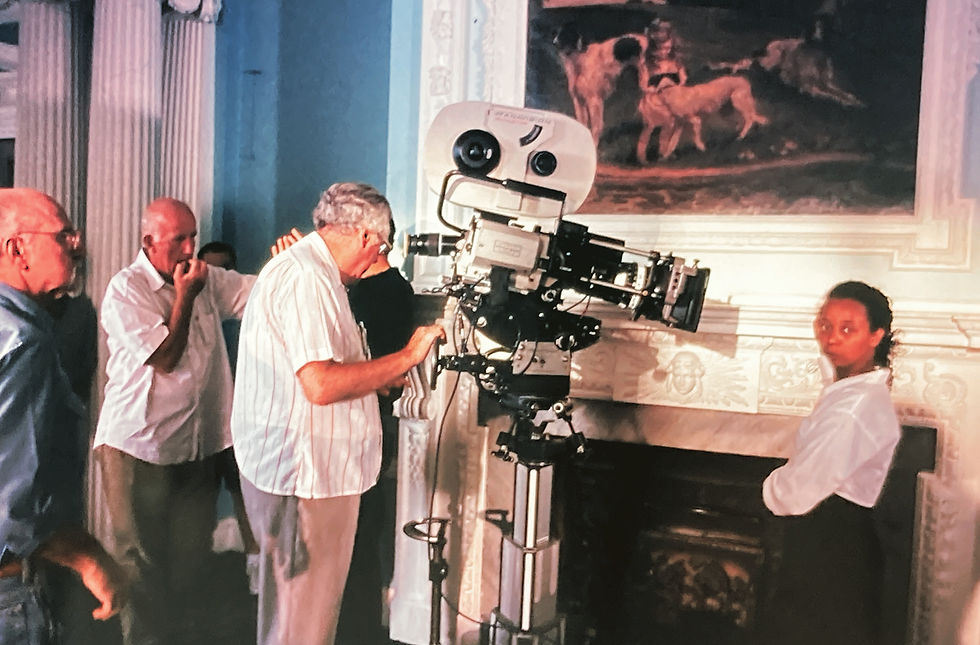
Frame from 35mm ORWO UN54 stock test I did. Panavision Panaflex Millennium XL2 and 50mm Primo lens.
Although this discipline comes from working with celluloid, the lesson applies just as strongly to digital cinematography. Shooting black and white — or even thinking in black and white while shooting colour — forces a more rigorous approach. It encourages you to judge contrast, shape and balance before worrying about palette. Many of the strongest colour images are made by cinematographers who are really thinking in tones.
Black and white also has a way of slowing you down in a good way. Because there’s nowhere to hide, decisions tend to be more deliberate. Lighting becomes less about adding and more about refining. Small changes matter. A flag here, a subtle lift there — suddenly the image breathes.
What black and white ultimately teaches is clarity. Clarity of intention, clarity of composition, clarity of light. It doesn’t forgive indecision or laziness, but it rewards confidence and restraint.
Strip away the colour, and what’s left is the craft.
Mark


Comments